Introduction to Clang for Clad contributors
Since there’s a lack of official documentation for the LLVM Clang, while the existing docs are not meant to explain how to modify the Clang AST, we are writing this text to help the newcomers get into the technical aspects of Clang useful for contributing to Clad and manipulating the Clang AST in general.
The big picture
So, as you probably know, Clang is a compiler. More precisely, it is a compiler front end that operates with the LLVM compiler backend. This means that the code you’re trying to compile will first be processed by Clang, which parses the source code and performs initial processing before passing it to the LLVM backend for optimisation and code generation. In this picture, Clad is an extension for Clang to generate derivatives of C++ functions along the way. That is, Clad synthesises the code for the derivatives while Clang is processing the actual code you have written.
The AST
Clang, parses the input code into an Abstract Syntax Tree (AST). It is at
this stage that Clad operates as well. The nodes in the Clang AST represent
various constructs of the source code, including: declarations, statements,
expressions, etc. As one can guess from the name, declarations (
clang::Decl ) represent places in the source code where something is
declared (a variable (clang::VarDecl), a function, etc.); expressions (
clang::Expr ) are basically something that can be evaluated to a
meaningful value, for instance binary operations (clang::BinaryOperator)
like addition or comparison; statements ( clang::Stmt ) could be a
lot of different things, like loops (clang::WhileStmt), conditions
(clang::IfStmt), breaks, etc – pretty much anything you have in your code.
An important note is that declarations (clang::Decl) and statements
(clang::Stmt) are completely different classes (so, a declaration is not
a statement), but there’s a separate declaration statement class,
clang::Decl, which describes a declaration statement to intertwine the
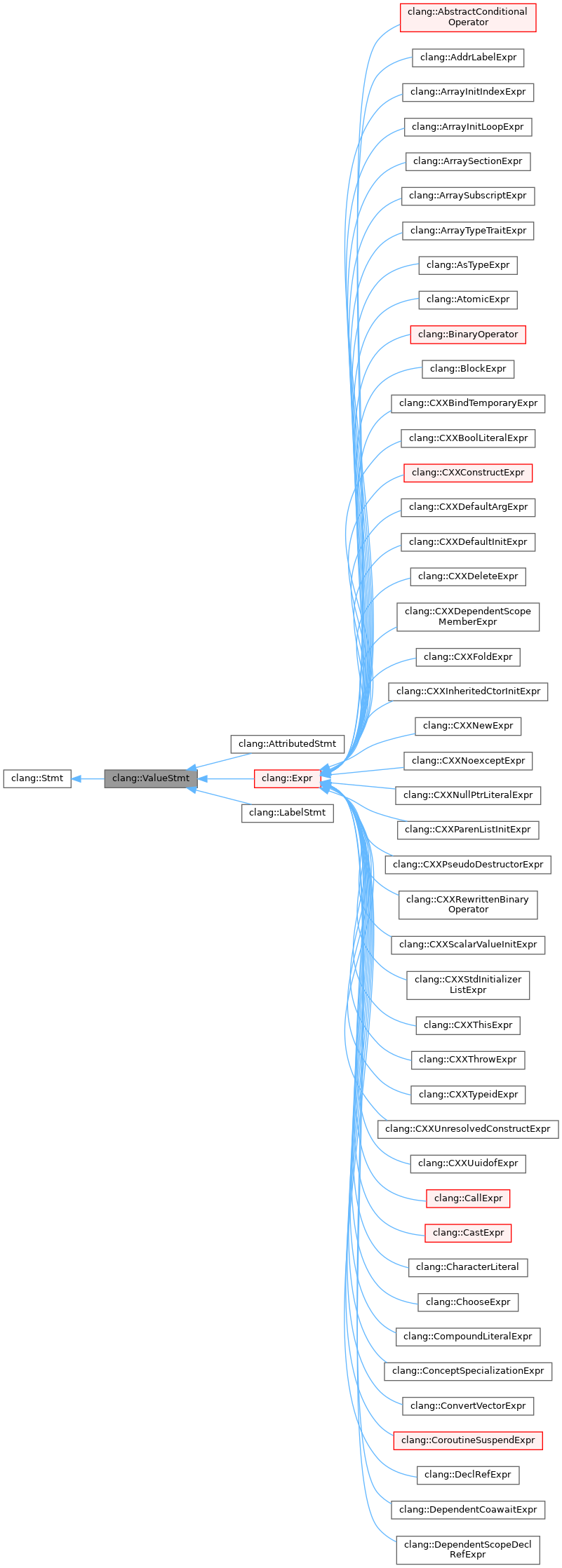
statements and declarations. An expression (clang::Expr), on the other
hand, is always a statement, since clang::Expr inherits from
clang::ValueStmt which, in turn, inherits from clang::Stmt and is a
statement.
Statements can be grouped into one with a compound statement
(clang::CompoundStmt).
Flow graph of Clad’s compilation
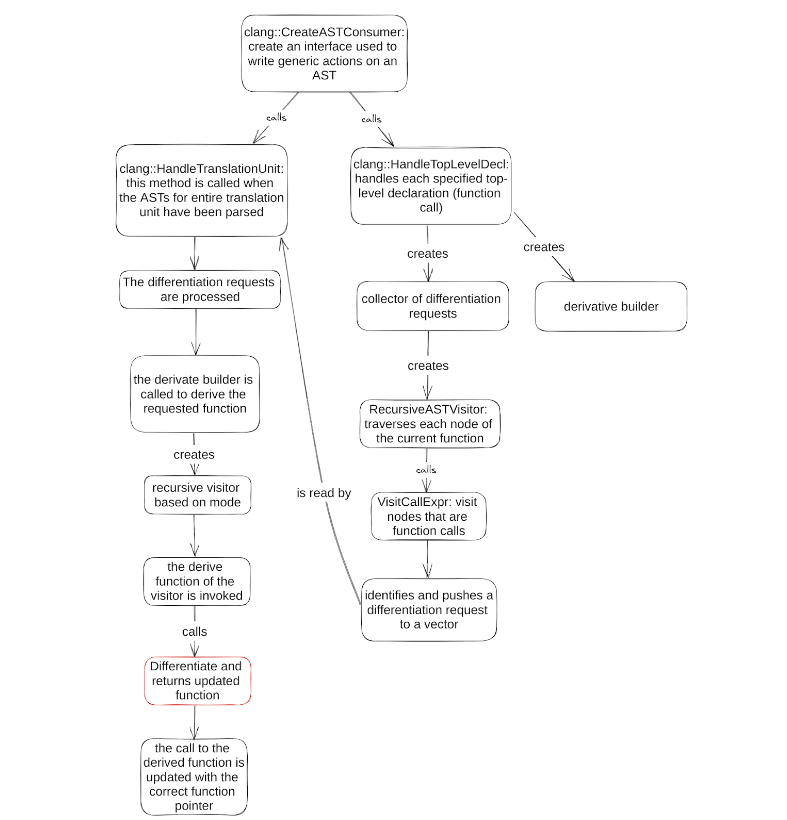
The graph below indicates the order of execution during compilation of the source code. Clang offers some API functions that work as entry points to the AST’s processing. These functions can be modified by the user and are invoked by clang. In our case, Clad has altered these functions accordingly, in order to compute and include the function’s gradient to the original source code. This source helps to distinguish the clang functions, their purpose and how they are connected. The most useful ones are explained in better detail in later sections.
Identifying functions to derive
During parsing of the source code through HandleTopLevelDecl(), a
RecursiveASTVisitor is created. This visitor traverses the nodes by using
the equivalent Visit() functions. For instance, a call expression, which
corresponds to a function call node, is processed through VisitCallExpr()
etc. Clad distinguishes the functions related to a differentiation request by
annotating a compiler attribute that matches the first letter of the
differentiation method to be used (e.g. “G” for gradient function). This way,
when VisitCallExpr() is called upon those nodes, the differentiation
request is identified, initialised and added to a list.
Similarly, any statement supported by Clad has a corresponding Visit()
method. An if statement would be visited by VisitIfStmt(), a return
statement by VisitReturnStmt(), etc. The general rule is that the Visit
method is called Visit+the name of the statement in Clang.
Code generation and insertion
After the parsing is completed and all differentiation requests have been
identified, the system can begin processing to compute the derived functions
through HandleTranslationUnit(). A DerivativeBuilder is created and,
depending on the Clad function used and its corresponding mode (forward,
reverse, etc.), the appropriate Visitor is defined. The Visitor’s
Derive() method is invoked, which contains a nested call to
DifferentiateWithClad(). This triggers a secondary processing of the nodes
in the original function.
During this traversal, for each node encountered, the corresponding node in the
derived function is created and returned to the parent node. The parent node
then emplaces this newly created node into the current code block of the
derived function. This process repeats until the traversal reaches the top
level of the original function, resulting in the complete computation of the
derived function.
Once the derived function is fully computed, its declaration is created,
including the appropriate body and parameters. A reference to this derived
function is then added in updateCall(), where the function to be returned
by clad::differentiate() / clad::gradient() is replaced with its
derivative.
Statement differentiation
Visit methods that we have just talked about earlier typically return a
clad::StmtDiff object. This is a Clad’s structure, so you can find its
definition in the code and explore its methods. It is basically a type that
contains 4 values, each one being a pointer to a clang::Stmt. Of these, the
following two values are crucial to understand:
clad::StmtDiff::getStmt()- this method gives you the statement contained in this StmtDiff object.clad::StmtDiff::getStmt_dx()- this method gives you the derivative of the statement contained by this object.
Let’s see how clang::NullStmt is handled in the reverse mode (reverse mode
differentiation is called by calling clad::gradient) as an example. Since
the null statement (which you can have by writing ;; at the end of a line
in the source code) represents an empty statement in Clang, it doesn’t really
affect the derivative in any way. So if this happens to be in the source code,
we just want to ignore it. In the reverse mode, Clad generates derivative
functions that consist of two parts: a forward pass and a reverse pass. Clad
produces a clad::StmtDiff object for each statement of the original
function where the object’s first part is what will be put in the forward pass
part of the produced derivative function and should basically do the same thing
as the original statement, whereas the object’s second part is basically the
derivative, which is put into the reverse pass. So, in the case of the null
statement, both of these should be nothing! Which is expressed by returning an
empty clad::StmtDiff from the visitor.
StmtDiff VisitNullStmt(const clang::NullStmt* NS) {
    return StmtDiff{};
};
Less relevant notes
This section is not that important, but it’s just a bunch of facts that might confuse a newcomer.
Clang AST might not seem like a tree (:D)! In a mathematical sense, a tree is a graph without cycles. While the AST itself is intended to be a tree and thus acyclic, practical considerations and additional structures can introduce references that might resemble cycles. So, some recursive constructs or templates in the source code might confuse you.
Clang can compile many C-like languages, specifically: C, C++, Objective-C, and Objective-C++. So, if you look at the documentation, not only are you going to see some general Clang classes and classes designed specifically for C++ compilation (those mostly start with a CXX- prefix), but also things that have an ObjC- prefix like
clang::ObjCAtTryStmtthat represent statements of the Objective-C programming language that you likely don’t need.